Oh yeah, I guess I have a blog, don’t I?
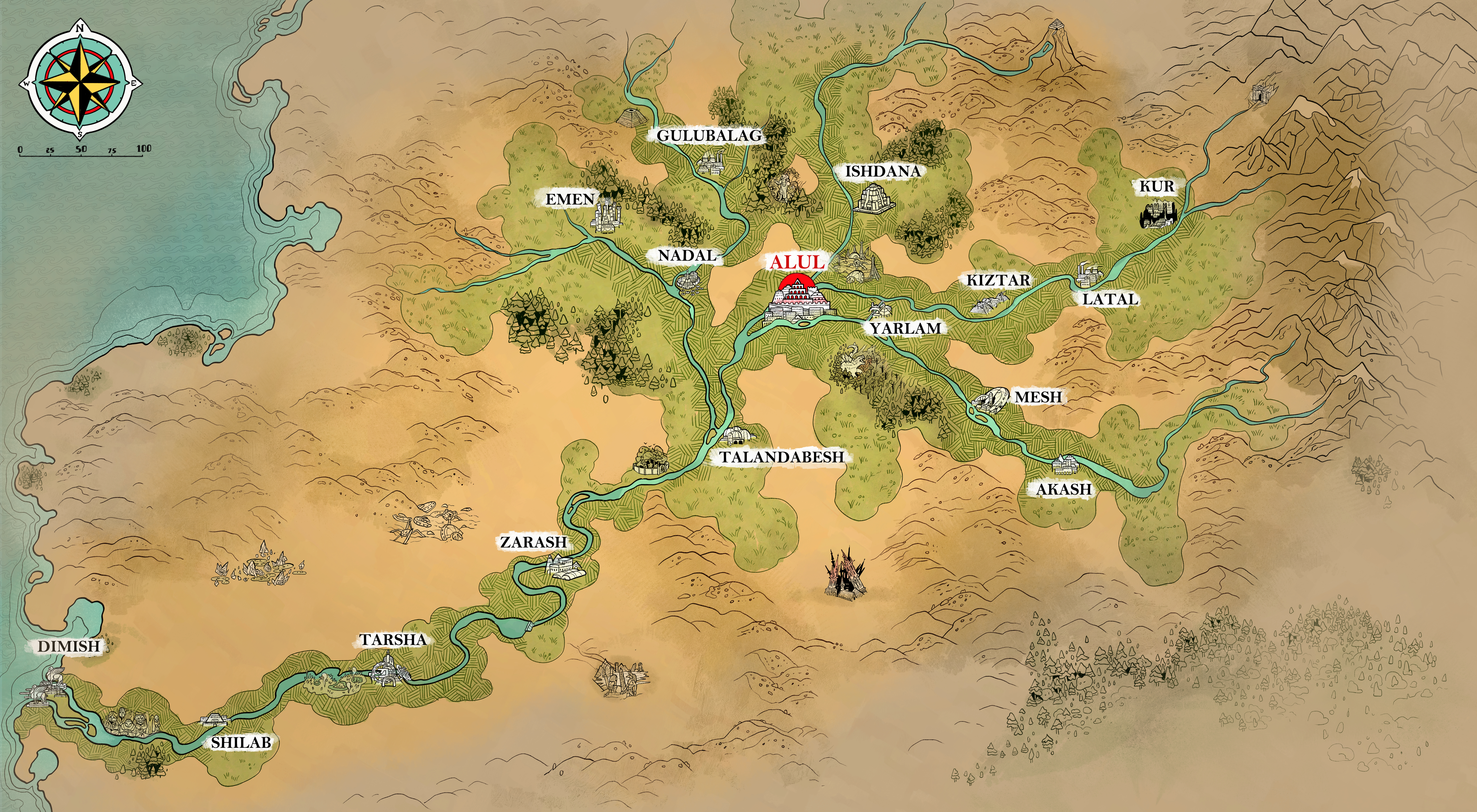
While once known by a number of names and inhabited by many peoples speaking many languages, the personal domain of the great Lugal is now known almost universally as the Capital Region. At the center of this domain is Alul, Seed of the Truth, the great capital city of the King of the Universe and the largest city in the world. The enclosed complex of palaces and temples at its heart rivals the size of any other city in the region. Surrounding it are the Four Great Rivers (inhabitants of Nadal count Five) and their cities, some dating back to before the Magob Tyranny and others settled more recently by the movement of peoples from far-flung places to the royal heartland. Every inch of land able to be irrigated is given over to farms or royal forestland. All of the rivers flow into the Royal Road, which carves a fertile green line through the deserts to the sea. These are the oldest lands of all, so old that its original language is no longer spoken outside of the ciphered court language of the Lugal and in magical texts. All cities within the Capital Region which end in the name element -sh, “Fortress” (or -sha, Outpost) were founded by these original people, from which the Lugal himself is said to descend. Except for Mesh, which was founded by people emulating that original population, and Akash, whose name is a complete coincidence. Names are fun.
Tribute flows from every corner of the world the Lugal rules, in the form of raw materials, riches, and prisoners. This tribute is then cataloged, stored, and processed into finished goods by the great Temple Factories of the many cities in the region. Some goods are shipped offworld to the Lugal’s other interests. Others are distributed back to the people of the region as gifts and rations. A great deal is shipped back to the lands where the tribute came from as reciprocal gifts to loyal rulers. The Capital Region is a beating industrial heart run on a palace economy, producing everything from barley and bread to laser rifles and spaceship parts.
Religion
The people of the Capital Region have a full understanding of the cosmology of the universe. They understand themselves to be on a ball of rock and metal, one of several hurtling around a star powered by chemical reaction and just one of millions of such stars in a galaxy, itself one of millions of galaxies. Thus, their religious beliefs are not so localized. The Great Cosmic Gods created the universe and established laws. The speed of light. The relationship of mass to gravity. Chronology. The physical features of matter. All of this was established by divine ordinance long, long ago. These distant, unreachable gods then divided the duty of maintaining these laws between an uncountable number of local pantheons, each in charge of maintaining a comprehensible reality within a particular region. Thus, the gods the people of the Capital Region worship are not universal entities but instead deities of their particular planet and region.
There is no singular theology. Each city maintains its own understanding of the pantheon. The High Priesthood at Alul has a different set of stories and rituals to any other priesthood in the region, even at other royal temples. The closest thing to an orthodoxy are complicated lists of equivalences and familial relationships among the gods, which determine, roughly, the political hierarchy of temple administrations descending down from the central royal temples.
For example, in Alul there is a temple to Kas-Anana. All temples of Kas-Anana thus owe loyalty and tithes of support to the central royal temple. Within the temple, a table of correspondence identifies the goddess Umi of Ishdana as being another name for Kas-Anana, and thus that temple also owes fealty. These tables also indicate that the minor goddess Lama is a daughter of Kas-Anana, and thus temples to Lama owe fealty to the nearest temple of Kas-Anana.
Even this is subject to change, as different tables of correspondence vie with each other for popularity. The relative power and prestige of gods and goddesses wax and wane along with changes in belief on which gods are related or which is in a dominant position, and political changes in turn affect the creation of new tables of correspondence.
The principal gods, agreed upon by most (though not all) temples in the Capital Region are:
Heh and Osi, Lord of Space and Lady of Matter: The first deities who shaped chaotic matter into the planets and charged their offspring with its maintenance. Not generally worshipped.
Zara, Lord of the Heavens: Creator of Blessed Winds and Storms alike. The inventor of astronavigation and the King of the Gods, charged by his father and mother Heh and Osi.
Kas-Anana, Mother of Civilization: The inventor of laws, judgement, regulation, recordkeeping, War for the Sake of Political Gain, and of sex and eating for pleasure rather than for survival. In short, everything that the people of the Capital view as separating people from animals.
Shilab, the Canal Inspector: The ambiguously gendered creator of humanity, for the purpose of transforming chaos into order for the gods. Tasked with ensuring the functioning of the mortal realm and with ensuring that fresh water bubbles up from the earth. Shilab hears and sees all, and conveys judgement to the other gods to determine the fate of mortals. Sometimes regarded as being the inventor of magic, or the violation of natural law to ensure that the greater order is protected.
Hamal, Mace of the Sun: Charged with ensuring that the sun’s light penetrates to the darkest corners. Vanquisher of Evil, Father of Growth, and inventor of War for Fun. Variously praised as the grower of crops and appeased as the lash of the desert.
Damal, Sword of the Moon: The more benevolent sister of Hamal, who watches over the sleeping world during the night. Associated with the fertility of people and animals, who nourishes children before they are born in the darkened womb and regulates the movement of animals.
Lurada, Mother of Life and Death: Queen of the Underworld, ruling from her lonely palace. Her servants shape the dead earth into humans, who are sent to the surface to live and serve and then return to exist as shades upon death.
Adarul, the Monster: A hideous beast, the very sight of which is enough to cause immediate death. Holds the chains of all demons, and sets them upon humanity to punish and ensure their readiness for war. The tormentor of the wicked and improperly buried. Never worshipped, only appeased. Said to be a god of the Magob who surrendered to the order of the gods in return for clemency. Beloved husband of Lurada, who is quite fond of him.
Social Order
The cities of the Capital Region have multiple overlapping spheres of governance. Theoretically at the top is the governor, a post that is in theory assigned by the Lugal but which is in practice a hereditary monarchy. It is the duty of the Governor to pass major laws, to sit in judgement during legal matters or to appoint judges to do so, and to lead the city in times of war. The palace is usually one of the largest landowners in the city, and the centerpiece of the economy as it employs swarms of bureaucrats, ministers, and laborers. Advising the governor and acclaiming each successor are the temples of each city, which usually are also massive landowners. Day to day affairs and small matters in each city are usually handled by a council of local notables and elders, most often in charge of a particular district.
In the past, almost everyone either directly worked for or rented from the palace or temple, but lucrative contracting arrangements have resulted in about a third of the population of each city instead working for or renting from private enterprises. These Great Households are contracted to run services or work on projects around the city, operate mercantile enterprises, or (more rarely) own land outright.
Society is broadly divided into four strata:
The High, who are granted land by the palace, a temple, or Great Household in return for some service or who are trusted enough to rent land in return for a portion of the harvest. All non-priestly members of this class are obligated to spend some portion of the year either in military service or on labor projects for the entity from which they have obtained land. Most administrators and specialist workers fall into this class, and make their living by renting to the next class.
The Laborers, who work directly for a major institution in return for a regular ration of food and goods, or for a member of the High as a tenant farmer. They do not owe labor or military service under the same levy as the high, but in practice are totally dependent on their patrons and will pick up spears and rifles if given the command. Depending on the city, they may also have fewer legal protections.
Slaves I mean, uh, Servants. We don’t have slaves in the Capital Region. We have Servants. Unfree people, usually foreign “barbarian” prisoners of war sent as tribute to the capital, people who have fallen into steep debt, or people sold by family members to cover debts. Almost all are owned by the palace or great temples rather than by individual households, and work the lowliest and most dangerous jobs in fields and factories. They retain some legal protections, especially those who are enslaved by debt, but still face innumerable abuses and indignities. There is immense social stigma to referring to what is very obviously slavery as such, because the liberation of the world from Magob slavery is such an integral part of the Lugal’s mythmaking.
Dust People, foreigners, refugees, and nomads who have no formal relationship with a palace, temple, or other recognized institution. While foreign travellers within cities are under the protection of the law, those who by choice or desperation fall in with the bands of Dust People at the edges of society are considered to be essentially outlaws. They can be killed or enslaved without legal repercussions. Despite this, they are sometimes temporarily employed for great labor projects or to serve as private and unofficial armies by the great powers of the region to wage war on one another. The default social position of player characters in my games.

Great Cities:
Dimish, the Gateway of the World.
The docks which receive all foreign tribute and send forth all gifts to loyal lands. Notable for the tremendous bronze Lamassu statues which symbolize the city as the symbolic gateway to the Capital Region. Everyone there knows it’s the second most important city in the Capital.
Shilab, Humble Land of the Honest
Notable for its lack of noteworthiness, Shilab has been long overshadowed by both of its neighbors. Though by no means small or poor, the city has little to distinguish itself and sometimes, humiliatingly, is left off of lists of great cities, and nobody thinks the city is particularly important.
Tarsha, the Jewel of the River
Lit by bright neon lights powered by the Temple of Hamal, Tarsha is a wonderland of vice and pleasure. Important functionaries of other cities often spend more time here than at official duties, making it the second most important city in the Capital. Spy rings proliferate like wild wheat. It is said that if one walks the length of the riverfront, one will end up at the other end naked and penniless. Not because of robbery, but because it’s impossible to not spend all your money and lose your robes throwing dice.
Zarash, the Breadbasket of the Capital
While each city and town maintains a granary, a significant portion of all grain collected in the region ends up stored in Zarash to be baked and distributed as rations to royal workers. Because it is named after the King of the Gods, everyone from Zarash agrees that it’s the second most important city in the Capital.
Talandabesh, Storehouse of the World
What Zarash is to grain, Talandabesh is to everything else. The largest collection of raw goods in the world, distributed by royal barge to various temples and institutions for processing. In possession of the largest army in the region, second only to the Lugal’s troops, for the purpose of escorting these barges. Easily the second most important city in the Capital.
Nadal, Gate to the Sky
Home to the Royal Spaceport, making it the second most important city in the Capital. Unique in that it is ruled almost entirely by the direct command of an appointed military governor, with no major landowning temples. The temples instead are devoted to the maintenance and command of one or more royal space vessels.
Emen, City of Spires
While Nadal has no landowning temples, Emen has no Governor. Instead it is run by a council of temples and private institutions, all competing for status. This manifests in a maze of towers attempting to prove once and for all who has the most wealth and power. The sheer number of commercial enterprises has turned the city into something of a financial hub, and the wealth of its banking temples makes it the second most important city in the Capital.
Gulubalag, City of the Pit
A thoroughly mundane city, with many factories. Because of longstanding historical ties with the pastoral nomads of the western hills, Gulubalag is flush with animal products such as wool, meat, and leather, making it definitely at least the third most important city in the Capital. It is also the friendliest and most tolerant to Dust People as a whole. At the very edges of the terrain administered by the city is the Great Temple of the Earth, a tremendously deep pit structure considered holy to most of the nomadic groups, though none agree on who the sacrifices thrown down the pit are being offered to.
Ishdana, the Temple City
Populated by various groups of resettled peoples, Ishdana is the newest of the Great Cities. It is constructed outward from an ancient Magob habitat, leaving most of the population living in one enormous complex that has built up and out over time. Wizards at sanitation and civil engineering, the population of the city has over time melded into a new multiethnic identity distinct from any homeland. The second most impressive city in the Capital.
Yarlam, the Canal City
Notable for the recently completed enormous canal which connects the First and Second rivers, undercutting tax collection in Alul and causing endless wailing and gnashing of teeth. Originally a fairly small city, Yarlam has been recently added to in population by waves of resettled peoples, leading to rapid growth and development, and the potential to become the second most important city in the Capital..
Kiztar, the Land of Divine Twins
A thousand years ago, this city was two cities. Over the centuries they have grown together, but both stubbornly cling to separate temple institutions while an increasingly beleaguered royal governor attempts to keep the peace. Presently, the two competing temples of Damal are racing to construct the largest and most impressive ziggurat temple complex possible and prove which half of Kiztar is the second holiest place in the Capital..
Latal, Eyes of the World
Latal is small and unimpressive compared to most other cities, but one crucial factor ensures that it remains the second most important city in the Capital: the temple of Shilab here possesses a near total monopoly on the precision grinding of lenses, absolutely vital to many of the most advanced industries in the rest of the region.
Kur, the Deep City
This city serves as a link between the Capital and the subterranean mountain lands granted by the Lugal to the trolls. The Trolls, who fought alongside the Lugal against the Magob, are unsuited to the sun of this world. Stony growths cover their skin if they spend too long in the sun. As a result, this city, which is nearly half troll in population, is largely underground. This makes it ideal for long term storage and preservation, and both its rich vaults and important symbolic value representing friendship with the Troll Kings make it the second most important city in the Capital.
Mesh, Ruins Built Anew
Sticking out of the earth at an odd angle is the remains of a great Magob mothership. Though tragically the first Mesh was crushed by the crashing ship, the New Mesh built in the skeleton of the ruins has become a manufacturing hub, repairing the facilities of the ship to create materials and technology otherwise outside of the scope of the Lugal’s means. Without any doubt, the second most important city in the Capital.
Akash, The City of Secrets
There is nothing notable about Akash. There are no secrets in Akash. There are no soldiers patrolling the borders of Akash and turning away travellers. There is no need for such a thing at Akash. There is no reason to travel to Akash. Akash offers nothing for you, and is best avoided. Akash is not the most important city in the Capital.
Alul, Capital of the World
Everything about Alul is bigger and more important. A city of millions surrounded by cities of thousands. The Capital of the World, where anything can be found. It is said that silver is as common as stone in other cities, and that even the poorest man can chew on rods of gold to fight hunger pangs. All of the world exists to feed Alul, be it food, materials, or population. The most important place on the entire planet, without question.
Next time, I’ll key the map’s important Points of Interest. Until then, enjoy the pretty pictures and ponder their meaning!
 Too Many Swords