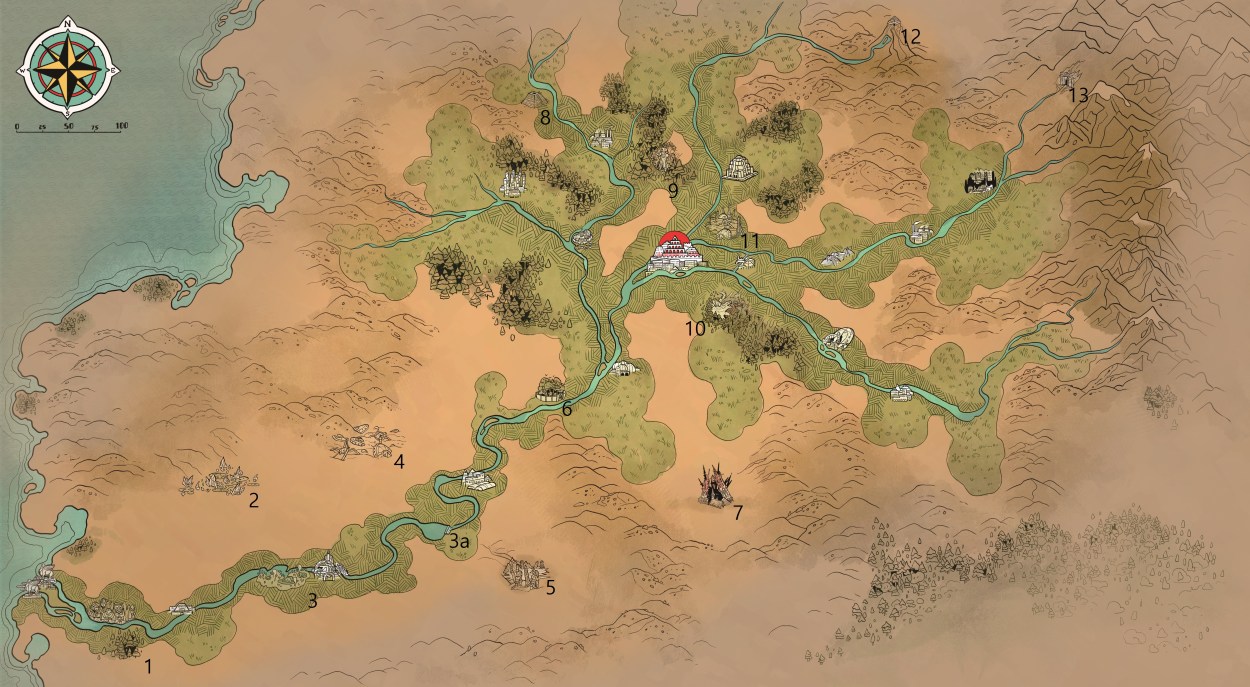
Two posts in a week, God help me. This was written in a bit of a frenzy to finally get the ideas out and in public, so I might go back and proofread it more later. Right now I’m lazy, so enjoy pure vomited ideas. The dungeons and locations attached to some of the locations are speculative at the moment. I don’t know if I want to actually run any of those at the moment, so consider them more potential ways to slot in stuff from elsewhere than straight up factually present in the setting as I’m running it.
The Wonders of the Capital Region! Tourists flock from the world over to marvel at the sights, the thrills, the slowly seeping toxic substances! Don’t get your soul eternally damned by being devoured by the Weather Beast!
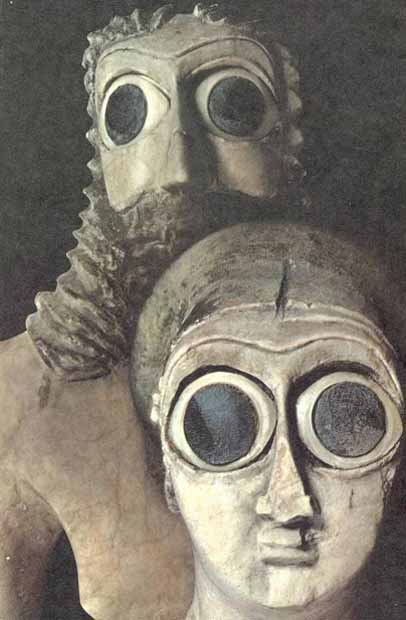
1. When the Lugal came to power, he issued a commandment: Let all the peoples of the world who swear loyalty send a representative to offer prayers to the gods for peace and tranquility as one unified chorus of voices. This was, for a while, an actual body of dedicated priests. For many centuries however, this role has been filled by thousands of votive statues representing the kingdoms, clans, city-states that swear loyalty to the Lugal arranged along the riverside between Dimish and Shilab. While once they were housed in a temple, now they are on display for all to see as a symbol of the universal nature of Kingship. Having a statue approved to be placed among the others by the Temple of Yuyulak, Mason of Zara in Alul has become equivalent to recognition as a direct vassal, and thus a mark of prestige and royal protection. Thus, the statues are hotspots for trouble, and soldiers frequently patrol looking for unauthorized statue placements or for the attempted vandalization of statues between enemy lands. The statues range in size from human-sized to large enough to hold small temples themselves, dressed in the traditional garb of their source populations, most with clasped hands or other signs of benediction, gazing serenely towards the sky.
2. The Magob sought to change the land and to make it hospitable to their kind. Centuries of war against the alien habitats, painstaking hacking back of alien tentacle vines and attempts to revive the soil for traditional crops, have largely been successful outside of some wild lands. The Crystal Fields, however, are a stubborn exception. Pools of toxic iridescent liquids make approaching difficult, and the odd crystalline growths appear to be frighteningly contagious. That every year one or two more pop out of the earth has long been of great concern. Long shunned as a cursed place, recent removal efforts centered around a near limitless supply of levied labor, hundreds of sledgehammers, and a total disregard for the sanctity of life have revealed something shocking: many of the crystals are hollow. This is where Tomb Robbers of the Crystal Frontier by the excellent Gus L goes.
3. Before the completion of the great irrigation systems that line every river in the region, floods were a near-constant danger. Even now, much of the levied labor gathered each year is spent dredging and maintaining canals to prevent potential tragedy. The Bone-White Marsh is a monument to the price for failure to keep maintenance. Once a productive stretch of land at some distant point in the past, a freak season of flooding along the normally relatively tranquil Royal Road led to a sudden inundation as the river suddenly broke free of its banks and altered course drastically. As the water evaporated, salt drawn up from the ground coated the land. Since then the land has been barren, salty and razor-sharp in some places and coated by deadly, grasping mud in others. Now it is avoided, for surely a place that remains so desolate no matter what attempts are made to reclaim it must be cursed. Perhaps some great crime against the gods both caused the flood and damned it to be a land of ghosts. The King’s Tollbooth Dam (3a), which now mostly exists to squeeze money from ships hoping to use its locks to travel upriver, was originally built to prevent such a thing from ever happening again. Only the desperate and mad come here now. This is where Across The White Marsh by Cyclopean Games goes.
4. The Magob have made efforts to retake their old prize. Three hundred and fifty years ago, one such effort ended in the destruction of a great many colonial motherships. They have remained, preserved in the desert, since that day. Many of these ships were of such size that they contained entire societies unto themselves. As they continue to produce toxic runoff, even embedded half way in the ground, many believe that these ships still contain life centuries later. One shudders to imagine the horrors that have taken place within these sealed and isolated tombs. Normally, such a great source of fuel and valuable parts would be stripped clean within a matter of days. The Lugal, however, ordered the boneyard to be closed and no scavenging to take place. The tomb ships were to remain sealed. Soldiers loyal to the Lugal were personally appointed as watchmen, and zealously drove away the curious and the adventurous. Only this order was told the true reason for the anathematization of the region. In recent years, with the Lugal not appointing new members, the order has dwindled, and some say has vanished entirely. Scavengers, thieves, and prospectors now dare to trespass in hope of finding valuables in the previously untouched mess of ships.
5. A city that defied the Lugal and dared to reject his kingship once dwelt here, along a river. Ruins of pyramids and obelisks, as well as humanoid forms made of a strange silvery metal, still jut out of the earth here around a lake of sickly green glass. The river was long ago dammed to create desert. While some visit to contemplate with awe the power of the Lugal, it is a shunned place for most. Still, the nomads of the hills who pass by here to trade in Zarash and Tarsha swear that deeper within the desert, along an old cliffside, some corner of this ancient civilization still stands. This is where the monumental Arden Vul by Expeditious Retreat Press goes.
6. The private hunting grounds of the Lugal. Outsiders are barred by pain of death, with guards posted around the entire walled perimeter to ensure that nobody can get in and that none of the humble servants blessed enough by the gods to be assigned there can ever leave. Almost five hundred square miles of forests and gardens, dotted by villages composed entirely of singers, dancers, cooks, and masseurs. There’s an empty lake ready to fill with wine; galleries of art dedicated to the Lugal’s greatness; at least two rollercoasters; and of course several thousand lions, tigers, panthers, and other big cats brought over from around the world to serve as sport for the King. This big game also serves as the prey for far, far worse beasts allowed to wander just in case the King decides he needs a change of pace.
The Lugal has not bothered to visit for 72 years.
7. The ancient capital of the Magob, left just as it was when they were overthrown a thousand years ago (or so the Royal Calendar says). Though a place of pilgrimage to shrink in thrilling fear at the bizarre spires and monstrous statues of genetic monstrosities, it is said that no person who dies within the city can ever enter the afterlife. A small temple scratches out a living here, offering charms to pilgrims to frighten away wandering ghosts. Such is the horror of this place that even demons do not venture here. Though stripped bare a hundred times over the centuries, the city is filled with forgotten basements and vaults that delve into strange unfathomable depths.
I’m not quite sure what to put here, honestly. Probably Operation Unfathomable, but maybe some weird science portals here and there as well.
8. Almost all of the nomadic religions in the hills north of the Royal Road and west of Alul hold the Great Pit to be sacred in some way, though most disagree as to which god it is dedicated to. Ancient even when the Magob were thrown off, the statues that once lined the great uneven blocks stacked atop one another to form a rough pyramid have long ago been broken or worn until unrecognizable, and scholars and priests disagree on whether or not the markings carved into some of the stones are writing or symbols of some other nature. Some hold that the animals, libations, and goods that are lowered into the Great Pit with cranes and pulleys are to comfort the dead in the underworld. Others believe that it is an offering to one cthonic god or another to preserve good grasses in the hills and the growth of the flock. It’s even sometimes identified as a site of some great evil, which needs to be continually placated to prevent escape. No matter what is down there, actually descending is considered profoundly profane and is likely to get the descent rope cut of anyone that attempts it.
9. A statue of the Lugal, carved into the hillside and gazing down upon his kingdom. In each hand, he holds the scruff of a lion. In and around the statue are chambers housing a number of temples dedicated to the preservation of the health of the King, and the statue is a tremendously popular tourist destination. The sheer number of soldiers stationed throughout the year, however, has led to a persistent rumor that deep within the cave complex some other treasure or knowledge is kept and preserved. This is wholly encouraged by the temples, who find the occasional robber a fair price for the prestige and glory of being a place of secret knowledge and power.
10. The Weather Beast, the monstrous attack dog of the gods, is permitted to rage here. He is not always present, as sometimes he is tasked with sending torrential rains, hurricane-like winds, and bolts of lightning down on the world. This keeps him busy most of the time. Very rarely, however, he will suddenly appear, screaming and battering the land while trying to free himself of the goading barbed chains affixed to him by Adarul. The rage will last a few hours, until he suddenly vanishes for weeks or months. The land is wholly devastated, and trees are scattered and mulched through the hills. The Weather Beast has attracted pilgrims who worship the taming of Chaos by the Law of the Lugal, as well as groups primarily made of escaped and former slaves who seek to soothe the beast’s agony or to break his chains and unleash his fury upon the land that has chained and brutalized so many.
11. Another site of crashed motherships, this one older. The crews did not survive, and the cracked open cores of their inexplicable reactors seeped into the land. Now, extraction efforts to recover the chemically potent but highly dangerous goop serves as the primary industry of an otherwise barren area known semi-ironically as the Golden Field. Once the runoff is collected, it is sent to Alul for processing into usable, if dirty, fuel, or diluted with olive oil into the cheap, highly flammable oil that is almost omnipresent in common lamps. In many ways Alul and most of the region is dependent on the fuel harvested here to power its factories and provide intermittent electricity to its temples. Yields are beginning to decline, further pressuring intrusion into the closed fields at Point of Interest 4.
12. A mountain rises from the hills in defiance of geological law. When people first stood at its foot, before the Magob ever came, they found carved temple doors with an engraved script that burned itself into the brains of even a pre-literate society: “The One Who Climbs And Slays A God Shall Seize Heaven.” Sometimes narrow halls, sometimes treacherous mountain stairways, the tangle of paths up the mountain and to the shining white temple on its summit are innumerable and dangerous. Generally now the mountain is held to be a temple of Hamal, Champion of Strife, and is populated by bands of devotees dedicated to fighting one another and honing their skills to make the ascent. As far as anyone knows, none have made the full climb, especially as most of the devotees are dedicated to ensuring that nobody they deem unworthy will ever make it.
13. The Gate of Friends is a lapis lazuli-covered gate, carved centuries ago to honor the special bond between the Lugal and the troll kings granted domains in the mountains. The entrance to an entire world of caverns, fungus-farms, and Trollholds. I really don’t know what the hell is going on down in the Trollholds yet.
 Too Many Swords